Xcode flaky tests
- Xcode test insights configured. Tuist detects flaky tests from the test-insight events uploaded by every test run.
Flaky tests are tests that produce different results (pass or fail) when run multiple times with the same code. They erode trust in your test suite and waste developer time investigating false failures. Tuist automatically detects flaky tests and helps you track them over time.
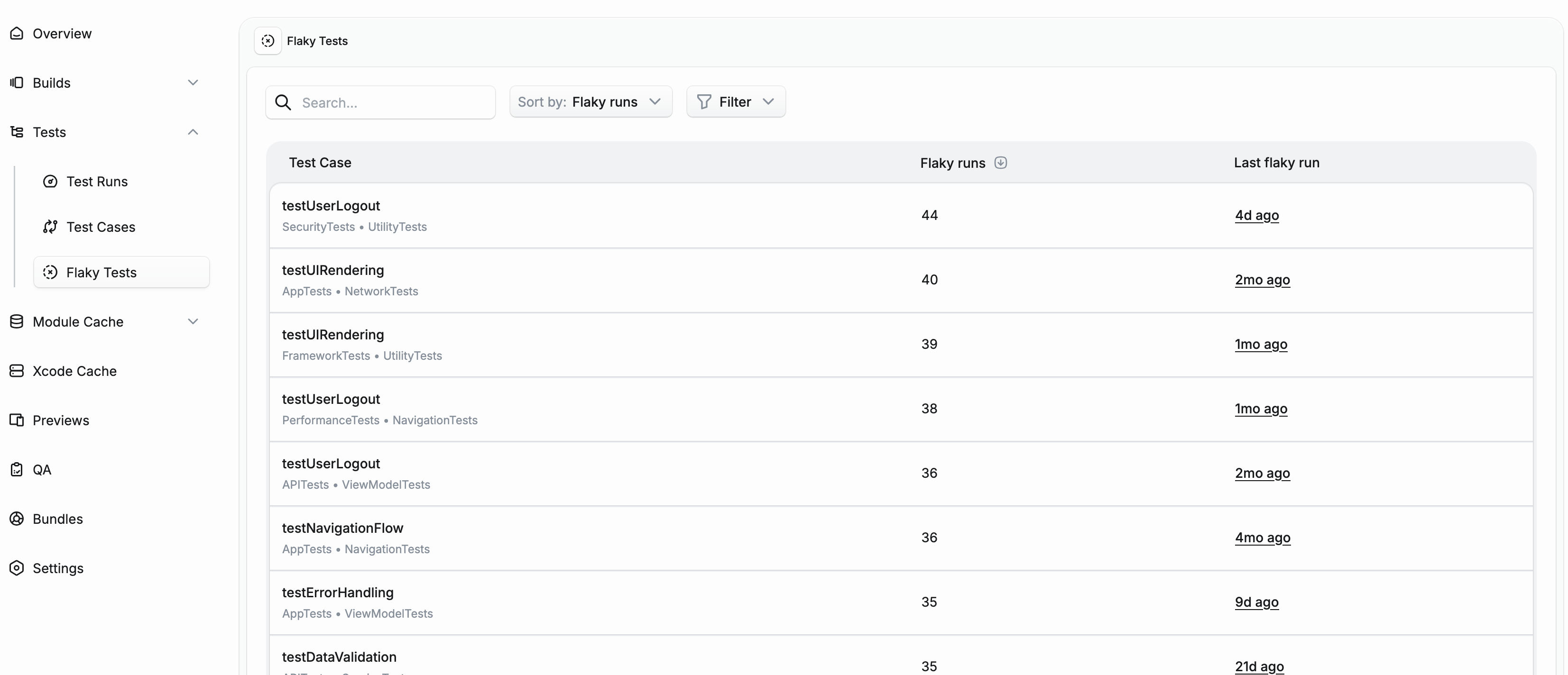
How flaky detection works#
Tuist detects flaky tests in two ways:
Test retries#
When you run tests with retry functionality, Tuist analyzes the results of each attempt. If a test fails on some attempts but passes on others, it's marked as flaky.
Pass -retry-tests-on-failure or -test-iterations through tuist xcodebuild test:
tuist xcodebuild test \
  -scheme MyScheme \
  -retry-tests-on-failure \
  -test-iterations 3
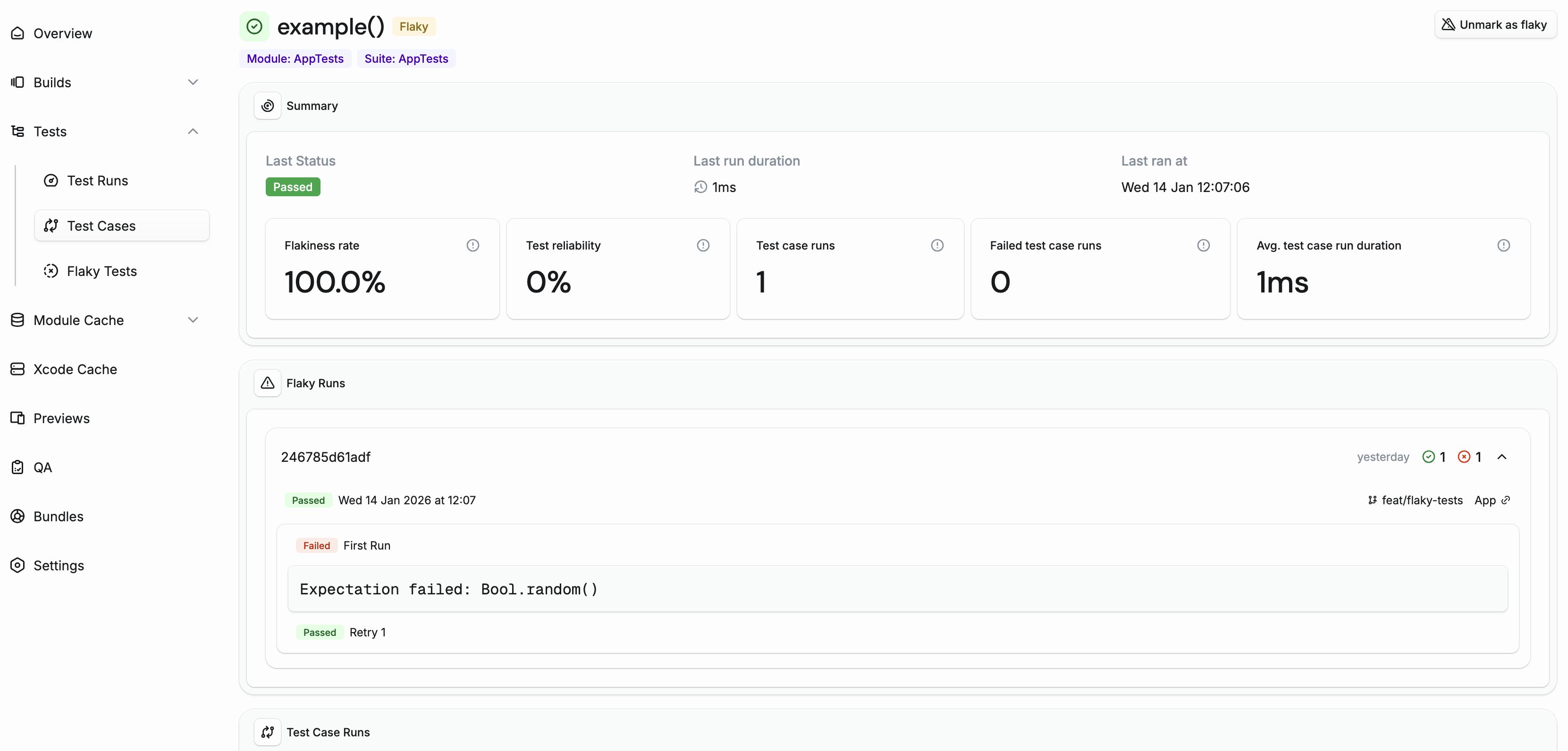
Cross-run detection#
Even without test retries, Tuist can detect flaky tests by comparing results across different CI runs on the same commit and the same scheme. If a test passes in one CI run but fails in another run for the same commit and scheme, both runs are marked as flaky.
The scheme is part of the comparison key because the same test can behave deterministically differently across schemes — for example, a snapshot test that's only valid against a specific simulator destination, or a test target that's compiled with different flags. Two runs of the same commit on different schemes are treated as separate execution variants and won't flag each other as flaky.
This is particularly useful for catching flaky tests that don't fail consistently enough to be caught by retries, but still cause intermittent CI failures.
Managing flaky tests#
Automatic clearing#
Detection and clearing run through an automation alert on the project. Every project gets a default "Flaky test detection" automation whose trigger marks a test as flaky and whose recovery clears the flag once the test has gone the configured recovery window (default 14 days) without re-triggering. Edit it under Settings → Automations to change the recovery window, swap the recovery actions (e.g. also un-quarantine), or disable recovery entirely so tests stay marked flaky until you clear them by hand.
Manual management#
You can also manually mark or unmark tests as flaky from the test case detail page. This is useful when:
- You want to acknowledge a known flaky test while working on a fix
- A test was incorrectly flagged due to infrastructure issues
Quarantining flaky tests#
Quarantining isolates a flaky test so it doesn't block CI while you fix it. By default it's a manual action — you quarantine, un-quarantine, and switch modes from the test case detail page in the dashboard — but you can also wire it into an automation alert under Settings → Automations so a test is automatically muted (or skipped) when it crosses a flakiness threshold, and un-quarantined when it recovers. Every transition, manual or automated, is recorded on the test case's audit log.
A quarantined test is in one of two modes:
- Muted: the test still runs, but
tuist xcodebuild testmasks the failure. Failures still feed the flaky-tests detector, so you can keep watching the test without breaking the build. Pick this for a test you're actively investigating. - Skipped: xcodebuild receives
-skip-testing <identifier>, so the test never starts. It produces no new results and drops off the flaky-tests dashboard until you re-enable it. Pick this when the test is broken, slow, or so persistently flaky that running it is just wasted CI minutes.
Why quarantined tests can appear as passing#
- Muted tests still execute. A muted test that fails is recorded as failed on the test case run and flagged as flaky — the per-test status is not rewritten. What gets overridden is the overall test run: if every failing test case in the run is muted, the run as a whole is reported as passed, so muted failures don't break CI.
- Skipped tests don't run at all, so the dashboard keeps showing the status from the test's last actual execution — that snapshot can be weeks old.
Running tests#
tuist xcodebuild test is a passthrough wrapper that honours both modes automatically. Use it the same way you'd call xcodebuild:
tuist xcodebuild test -scheme MyScheme
Skipped tests are appended to your xcodebuild invocation as -skip-testing <identifier> and never start. Muted tests run normally; if they fail, the failure is masked in the resulting build status.
Bypassing quarantine#
tuist xcodebuild test accepts --skip-quarantine to run everything, including muted and skipped tests:
tuist xcodebuild test --skip-quarantine -scheme MyScheme
Calling xcodebuild directly#
If you can't go through tuist xcodebuild test, expand the quarantined tests into -skip-testing arguments yourself with tuist test case list:
xcodebuild test \
  -scheme MyScheme \
  $(tuist test case list --quarantined --skip-testing)
This is the safe default outside tuist xcodebuild test: failure masking for muted tests only happens when you go through that command, so skipping both modes avoids spurious CI failures. If you need finer control, go through tuist xcodebuild test instead.
Stress-testing new tests#
The stress gate reruns the test cases your branch adds, several times each in a fresh process, and reports the ones that turn out flaky. You see a new flaky test on the pull request that introduced it, not weeks later.
A test case counts as new when it hasn't run in CI on the project's default branch in the last 90 days.
Enabling it#
The gate is off by default. Set a mode:
report: warns about each flaky test case. The run still exits on its own result.enforce: a flaky test case fails the run, with the same exit code as a failed test.
Start with report for a couple of weeks to see what enforce would have blocked.
Pass it ahead of the passthrough arguments, or set TUIST_TEST_STRESS_NEW_TESTS to vary the mode per CI lane:
tuist xcodebuild test --stress-new-tests report -scheme MyScheme
How many times each test reruns#
It depends on how long the test case took on the first pass:
| First pass | Reruns |
|---|---|
| Up to 5s | 10 |
| Up to 10s | 5 |
| Up to 30s | 3 |
| Up to 5min | 2 |
| Over 5min | Not rerun |
Reruns reuse what the first pass built. The pass stops at 200 test cases or 10 minutes, whichever comes first, and says which limit it hit.
When the gate doesn't run#
- The first pass already failed. Fix those tests first.
- The project has no default branch, or nothing has run in CI on it yet.
- More than 30% of the project's test cases look new. Rerunning that many would take longer than it's worth. Expect this on a project that only just started reporting to Tuist, or after a rename that moves a lot of tests at once.
Slack notifications#
Get notified instantly when a test becomes flaky by setting up flaky test alerts in your Slack integration.
Querying flaky and quarantined state#
CLI#
The tuist test case command tree exposes everything Tuist tracks about a test case:
tuist test case list --flaky                       # only flaky test cases
tuist test case list --quarantined                 # only muted or skipped test cases
tuist test case show <test_case_id>                # detail: flakiness rate, last status, run counts
tuist test case events <test_case_id>              # audit log: marked_flaky, muted, skipped, ...
tuist test case run list <test_case_id>            # run history with status and duration
tuist test case run show <test_case_run_id>        # single run, including failure breakdown
All of these accept --json for scripting.
REST API#
The same data is available over HTTP — see the Test Cases endpoints in the API reference for the full list of routes, filters, and response fields. State changes (mark/unmark flaky, mute, skip) currently happen from the dashboard UI, not via the public REST API.