Copy logo as SVG
Copy wordmark as SVG
Download brand assets
Brand guidelines

Changelog

Product

Code coverage for Gradle projects

The Tuist Gradle plugin now uploads the code coverage of your test tasks. Turn it on with coverage { enabled = true } in the tuist block of your settings.gradle.kts, or with TUIST_TEST_COVERAGE=1 for a single invocation, and the dashboard's Code Coverage page shows each commit's figure, its modules and files, and a trend for each branch.

The plugin measures your tests with JaCoCo and keeps only your repository's product code. For JUnit Platform tests, it also records which code each test ran, so when a run leaves tests out, Tuist carries their coverage forward from an earlier run instead of reporting the commit as complete. Sharded runs merge into one figure, and test tasks restored from the build cache still report their coverage.

Run ./gradlew tuistCoverageComplete once every test job of a commit has finished. See the Gradle code coverage guide to get started.

Product

Tuist insights on Entire Trails

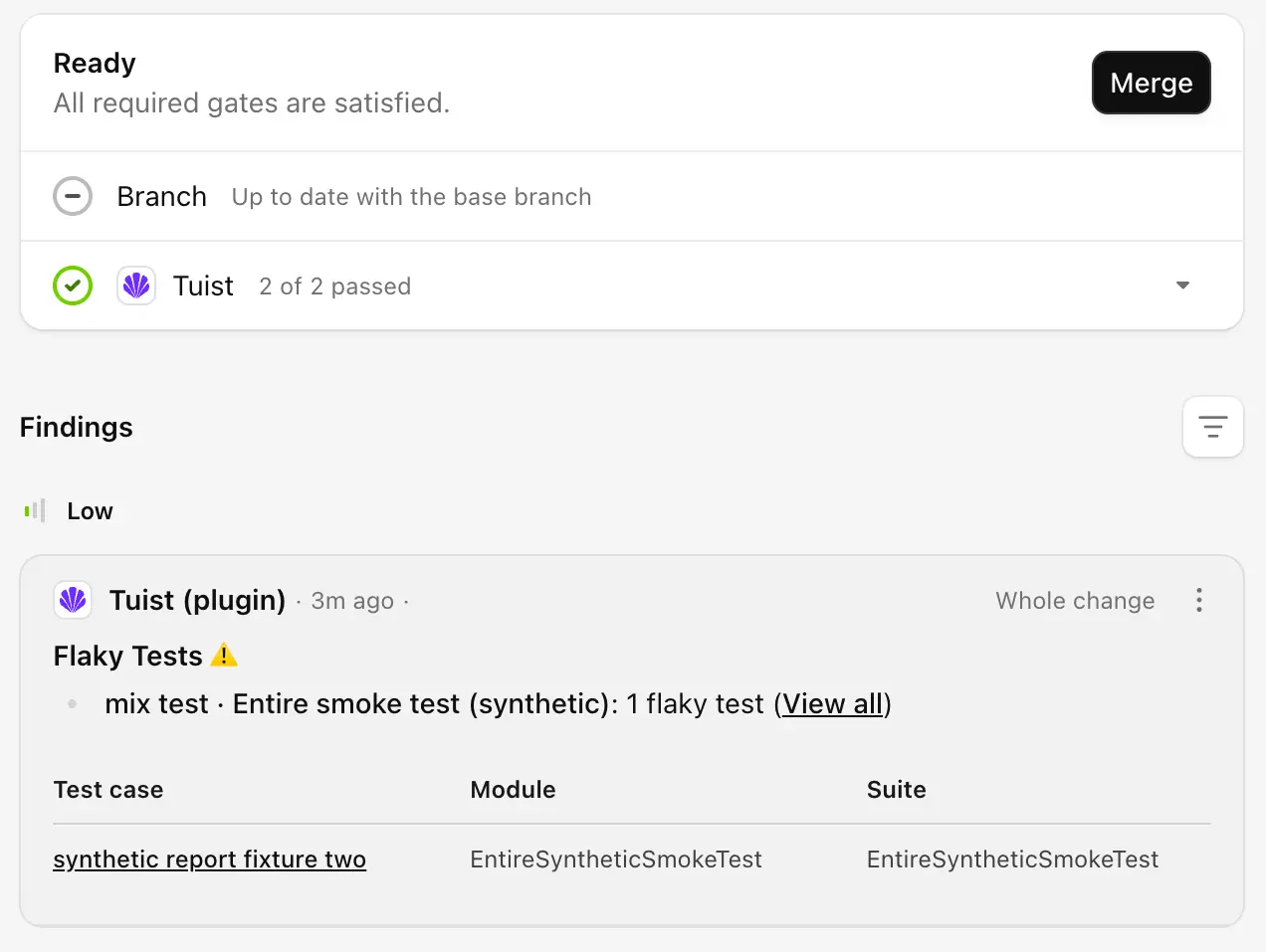
Tuist now publishes to Entire Trails, next to its GitHub and Cursor Origin integrations. Each open or draft Trail gets a Tuist gate with the run report, and failed or flaky tests appear as Findings that link straight to the test case on Tuist.

An Entire Trail with the Tuist gate passing and a Tuist finding that lists a flaky test case with its module and suite

The screenshot shows a test fixture that is labeled synthetic.

  • Follows the Trail head: Tuist matches uploaded insights to the Trail's current commit, so a report always describes the code under review. When a newer report arrives, Tuist resolves findings it no longer contains.
  • Informs without blocking: the Tuist gate reports what your uploads observed and never blocks merging, even when there are findings. Keep your CI provider's required checks for pass/fail enforcement.
  • No CI changes: keep uploading builds and tests with your existing Tuist commands. Tuist does not need Entire-specific flags, its CI executor, or access to your source code.

The integration is in early access. To get started, open your account's Settings → Integrations, select Install Entire plugin, then add a project connection. See the Entire integration guide for setup and self-hosted configuration.

Product
Product

Filter bundle sizes in Slack reports by tag

You can now filter the bundle-size section of your Slack reports by an uploaded bundle tag. For example, select production to report production app sizes while continuing to upload debug builds to the same project.

Open Project Settings → Notifications → Reports → Included in reports → Bundles → Edit, search for a tag, and save your selection. Scheduled reports and test reports use the same filter, and size comparisons use a previous bundle with the same tag, app identifier, and artifact type. If no bundle matches, the report leaves out the bundle-size section rather than using an unrelated upload.

Select All bundles to remove the filter. Other report metrics are unchanged.

Product

Sign in with passkeys

You can now sign in to Tuist with a passkey instead of a password. A passkey is unlocked with your fingerprint, face, or device PIN, and it only works on Tuist's own site, so it can't be phished.

To add one, open Account Settings → Authentication → Manage two-factor authentication and click Add a passkey. Your browser or password manager, such as 1Password, iCloud Keychain, Google Password Manager, or Windows Hello, stores it for you. You can add several passkeys, see when each was last used, and remove any you no longer need.

Then pick Log in with a passkey on the login page, or choose your passkey from the email field's autofill. A passkey sign-in already confirms both possession of your device and your identity, so it also satisfies two-factor authentication. If you sign in with a password, GitHub, Google, or SSO and have the authenticator app enabled, you can use a passkey instead of the six-digit code.

Organizations that require single sign-on still require it: a passkey doesn't replace your company's SSO.

Product

Browser agents can use Tuist's tools through WebMCP

WebMCP lets a web page offer tools to the agent built into the browser. In a browser that supports it, Tuist's pages now register Tuist's MCP tools, so you don't need to add an MCP server first.

  • Website and documentation: the agent can search Tuist's documentation and source code, without you signing in.
  • Dashboard: once you're signed in, an account's pages offer the read-only tools coding agents use, so the agent can look up that account's projects, builds, test runs, bundles and previews. The calls run as you and only reach the account you're looking at. When you switch accounts, the tools switch with you.

Tools that create, change or delete data aren't offered in the browser, because the agent gets these tools without you choosing to add them and reads content that builds and tests produce. To use those tools, connect an MCP client to Tuist's MCP endpoint. If an organization enforces single sign-on, sign in to the dashboard with its provider to use its tools.

Product

Single sign-on enforcement now covers the Tuist CLI, app and MCP clients

Organizations that enforce single sign-on already required it on their dashboard. Signing in to the Tuist CLI, the Tuist app, an MCP client or the API reference creates a credential that acts for you in every organization you belong to, so that now requires it too: if you signed in another way, Tuist sends you to your organization's provider first, and sign-in with an email and password or with Apple is refused.

The check also runs whenever one of these clients renews its credential. Existing credentials keep working if you have signed in through your organization's provider before. Otherwise they keep renewing for four weeks, and then the client asks you to sign in again; signing in through your provider once in that time, on the dashboard or with tuist auth login, avoids it. If you belong to several organizations that enforce single sign-on, one session can't satisfy all of them, so ask an organization admin for help.

Product

Tell us when the Tuist MCP server gets in your agent's way

Coding agents connected to the hosted Tuist MCP endpoint can now use a report_feedback tool when a Tuist tool or prompt does not work the way they expected: a confusing or wrong result, an error, missing data, an unclear parameter, or a capability they needed but could not find.

Agents suggest a report and send it only once you agree. Each report describes what was expected, what actually happened, and optionally a suggestion for a better tool, and it can name the account and project the problem happened in. The report opens a conversation with Tuist support under your name, so we can follow up with you by email and turn the feedback into improvements to the tools your agents rely on.

Reports should not include source code, secrets, or personal data. The tool is available to agents signed in to a Tuist account.

Product

Open your build timelines in Perfetto

Build pages for Xcode, Gradle, Bazel, and Mix now have a Download trace button in the header whenever the build has a timeline. It downloads the build's recorded steps as a trace file that you can open at ui.perfetto.dev, chrome://tracing, or Perfetto's trace_processor. Steps are laid out in lanes by how many ran at the same time, so the number of lanes shows the build's peak parallelism. CPU and memory appear as counter tracks when the build recorded machine metrics.

Coding agents connected to the Tuist MCP server can use the new get_build_trace tool to get the same file. It returns a download link that is valid for one hour, so an agent can fetch the trace with curl, query it, or hand it to you to explore in Perfetto. The trace contains the same steps as the build's Timeline tab, without logs.

Product

Security updates for TLS certificate validation

We have released security updates in response to the eMudhra certificate compromise. We recommend upgrading each Tuist component you use to the patched release listed below.

What is the risk?

When an application connects over HTTPS, it checks a certificate to confirm that it is talking to the right server. Certificate authorities are the organizations trusted to vouch for those certificates.

Compromised eMudhra certificate keys can be used to create forged certificates that some applications still trust. An attacker who can intercept a connection could use one to impersonate the intended server and read or change data sent over that connection, including credentials. This is often called a man-in-the-middle attack.

The problem concerns how applications verify the other end of a connection, not a break in TLS encryption itself. Different applications can use different certificate stores, so updating a browser or an operating system alone does not necessarily protect every application.

What we changed

The updates reject certificate chains that use the affected keys and update shipped certificate stores where applicable. Normal certificate and hostname verification remain enabled, and unrelated private certificate authorities remain supported.

The fix is available in these stable patch releases:

ComponentPatched release
Tuist CLI4.214.1
Gradle plugin0.18.1
Elixir SDK (tuist_ex)0.10.1
Tuist macOS app0.27.2
Self-hosted Tuist Server1.355.1
Kura0.59.1

These versions identify the patched releases on their respective stable release lines. Updating a self-hosted server does not update installed clients, and updating a client does not update a self-hosted server.

What you should do

  • Upgrade each component you use, including versions pinned in CI and project dependencies.
  • Restart running clients and replace or recreate server and Kura containers with the fixed versions. Changing an image tag does not update an already-running container. Follow your normal upgrade and rollout checks.
  • Keep your operating system and TLS libraries updated as well.
  • If an endpoint starts failing certificate checks, repair its certificate chain. Do not disable certificate verification to work around the error.

If you need the fix backported to an older release line, contact us with the component and version you run.

What about past connections?

The updates address the risk of future connections trusting the affected keys. They do not establish whether a past connection was intercepted. Certificate-based impersonation may not leave a clear trace in application logs, so an absence of reports or log entries would not prove that no interception occurred.

If you suspect exposure, contact us so we can help assess your situation and any additional steps needed.